
A student adjusts to the financial and cultural challenges of living on his own for the first time.
Antoine arrived in Tunisia on a scholarship from Ivory Coast. Though grateful for the opportunity to study in a more developed country, he describes the difficulties of navigating an unpredictable academic program and a new culture. Antoine reflects on the financial and social support he has received from family and friends and looks toward the future, aspiring to pursue his master’s degree and move to Europe.
I come from a modest family, but we have always been able to take care of our financial issues – thank God. My childhood was stable and happy. Even though we were not very rich, we had what we needed. My dad used to be a commercial agent and my mother is a house cleaner. My dad has three wives, and I have fifteen brothers and sisters. We all live together, and we are all really close; we never fought when I was growing up. Today, I am the only one in my family to be out of the country.
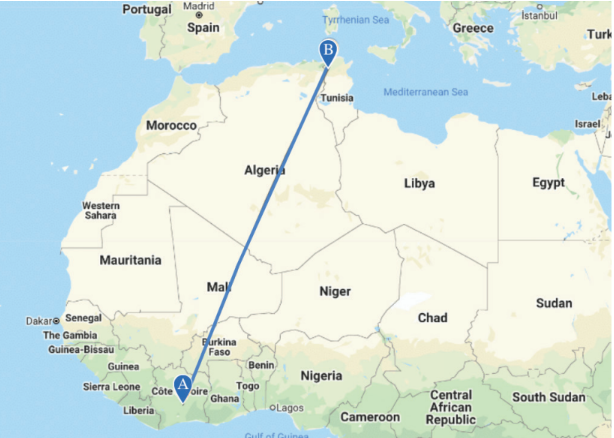
As I finished high school in Ivory Coast, I wanted to pursue advanced studies at a university. However, I knew that my Baccalauréat in Electronic Sciences, a technical degree, wouldn’t help me get into a good university. My younger brother told me about a friend who had completed the same high school program as I had and then went abroad for university. My brother called my aunt, who used to work at the Ministry of Foreign Affairs, and she said I could learn more at the scholarship service desk. The desk told me that there were scholarships available for Morocco, Algeria, and Tunisia. My first choice would have been Morocco because it’s the most open-minded, but those scholarships were taken since the summer had already ended. Instead, I applied for Tunisia, thinking that the country was at least more open than Algeria. My brother helped me with my application, and the whole process only took about two or three weeks. I learned I had received the scholarship around October 20th, and by the 26th, I had left the country.
The scholarship only covered my tuition fees and accommodation, so my family took care of most of the expenditures. For example, the ministry recommended a specific travel agency to book my flight, which cost 280,000 CFA ($481 or 1,437 TD). Even though we weren’t required to use their agency, we thought they would have recommended the cheapest option. I later found out there were less expensive options, so I think there might have been some collaboration between the ministry and the agency. You know, maybe the ministry got a small percentage from the agency.
I didn’t know anyone else who was going to Tunisia. I met the other scholars at the airport. I was sad to leave my parents but happy that I was going to a more developed country where I could study something that I couldn’t in Ivory Coast. Before I left, my parents gave me about 250,000 CFA ($429 or 1283 TD) as pocket money and 50,000–100,000 CFA ($86–172 or 257–514 TD) to spend on clothes, school materials, and anything else. When we landed, we were welcomed by Ivorian Embassy staff and taken to the embassy to pay 5 TD ($1.70) for a consular card and 35 TD ($11.70) to join the Association of Ivorian Students. At first, we didn’t want to pay to join the association – we’re already Ivorian, why would we have to pay?! But we were new, and we didn’t know, so we paid as we were told. We didn’t want to have problems. After taking our money, the staff disappeared from the embassy. These same fees still apply.
The first days in Tunisia were really tough. We had paid the fees, but it didn’t feel like we had any associative support. We were welcomed by a ‘dean,’ an older Ivorian student who had already spent time in Tunisia, and he told us what to do, but then he left. The administrative paperwork was easy and getting our residency was quick, but I think it cost $0.10. The dean also told me to open an e-dinar account – it was really easy. It’s the first bank card I’ve ever had, and I put all the money my parents had given me (250,000 CFA or 429 TD) onto my account. Ultimately, I regret paying to join the student association; I wouldn’t do it again. They don’t help us at all with getting jobs or internships. We’re on our own for the important things.
When we first arrived, we weren’t familiar with the currency, so we spent a bit more. For example, in small grocery stores, we [Sub-Saharan students] were sold things like soda, sweets, oil, etc., for a bit more than regular prices. Not much more, but they might randomly charge us an extra 500 millimes ($0.20), 1 or 2 dinars ($0.34–$0.68). Also, many times, I thought two-dinar coins were one-dinar coins. I would accidentally give away two dinars and the shop owners would keep the extra change without saying a word. It depends on the area you’re in, though. If you’re in a neighborhood where there are a lot of Sub-Saharan students, the shop owners know that we know the prices and won’t try to rip us off. If you go a bit farther, they might try.
Adapting in Tunisia has been the toughest thing – adapting to life without my parents, to doing everything on my own. The scholarship is supposed to send us money every two months, but there are a lot of delays, so the amount varies every time. Before I left Ivory Coast, the ministry didn’t tell us anything about how much money they would give us. They said our parents needed to contribute, and my parents were okay with that. My parents tried to ask at the embassy how much they should plan on sending me, and they were told 100,000 CFA ($172 or 514 TD) per month. My brother is the one who sends me money and takes care of me financially. I only ask him for money when I need it, which is usually every two months. I don’t ask him for a specific amount, but he usually sends about 100,000 CFA ($172 or 514 TD) per month. Sometimes my mother sends me money, but I never ask her to do that. She just sends it to be nice to me. She’ll call me and say, ‘I’ll send you some next week.’ She does this maybe four or five times a year, usually 50,000 ($86 or 257 TD). My brother always uses MoneyGram because he says the fees are better. My mother uses Western Union. Once, I told her the fees were lower with Western Union — which they were at the time — and since then, she just sticks with Western Union. I’ve told her my brother prefers MoneyGram, but she’s gotten used to Western Union.
When I was growing up, my parents taught me to save my money, so I have been able to at least save some since I arrived here. I don’t have a savings objective per month, but I try to reduce my expenditures. I only buy what is necessary and I don’t really leave town, except in the summer for work or internships. I don’t like to keep cash with me because it’s harder to make sure I have enough until the end of the month. I prefer to keep it away from me,” Antoine laughs. “In Ivory Coast, when you’re given money, it’s just for a period and you have to be responsible for it. You can’t ask for more because you ran out. Even if we didn’t manage to make our money last, at least we knew it was our responsibility. So yeah, I’m a bit responsible. A bit,” Antoine laughs again.
Whenever I’ve needed money, I’d go to the post office and use its ATM to get cash out because it doesn’t have fees. The problem is that we often have network issues and the ATM doesn’t work. This year, after using it for two years, I’ve stopped using the e-dinar card that the student dean told me to open when I first arrived. The card expires every year and you need to pay a fee, around 14 TD ($4.70), to renew it. Since this might be my last year here, I didn’t think there would be a point in getting a new one and paying the fees. I usually don’t like to borrow money from friends, but I often have to if my brother is tight on money or if the end of the month has come and I’ve run out. In most cases, I ask one of my housemates, a close friend, to pay for my rent, and then I reimburse him within a week or two, once I get my money. Often, if someone asks me for money, I’ll tell him that I can’t give you that much, but I can give you a bit. This happens maybe two or three times a year for 50–100 TD ($16.73–$33.46). I don’t have expectations on when I’ll be reimbursed, and I won’t call you to ask you to pay me back. It’s whenever you can.
I’ve never tried to send money out of the country. Even to leave the country and change money to euros is difficult, if not impossible. You need the first receipt and all the receipts you’ve ever gotten to change euros into dinars. You also need proof that you’re a student before making your request. When I arrived the first time, I changed CFA into euros at the airport, and then euros into dinars at the airport in Tunisia. I didn’t think of changing money into dollars because Tunisia is francophone, so I thought euros would be better. I don’t know if I’ve kept that receipt. My parents don’t expect me to send them any money, though. They are parents – all they want is for me to be well. They are just happy that I am able to be financially independent. They don’t need my money. They just want to make sure that I can take care of myself and my own family in the future.
I stayed in the student halls for a week, but then moved out; the living conditions were too bad, especially the bathroom. My friend found a home for us and two other students, and we all lived there for a year. We each paid 100 TD ($33.40) a month, with everything included. That first landlord took advantage of us while we lived there. When we first moved in, we wanted WiFi, so we went to the store with him. The WiFi was registered in our landlord’s name, but my friends and I paid the bill each month. When we’d leave during the summer, we told him we wanted to pause the internet since we wouldn’t be there, but he said he couldn’t come with us to the store. In reality, he and his kids were using the WiFi for themselves because they lived just above us. I considered his kids my own, so I shared the password with them, but they overused it all the time. Every month, the bill reached 50 TD ($17), but the family never wanted to pay for it or even contribute.
By the end of the second summer, our landlord increased the rent from 300 TD ($101) to 400 TD ($135), which was too much for us. My friend said we should talk with him and negotiate it to 350 TD ($188), but he wouldn’t accept our offer. He said we were not taking great care of the house and that we made too much noise, and I think he was right. Maybe he increased the rent so that we would leave, which we did. We found something similar for the same initial price.
When we moved out, we wanted to take the WiFi router with us. Our landlord refused to give it to us, saying that other people would move in and need WiFi. We had every right to take the modem. We had paid for it! We tried to explain the situation to the employees who sold us our membership, but they said there was nothing they could do since the contract was in our landlord’s name. Ultimately, we had to buy a new router for the new place, but we took a 30 TD ($10) fixed contract. This experience spoiled our relationship with that first landlord. My friend who knew him better than I did was really upset. The landlord’s family still invites us over for dinner sometimes, but we never want to go. Everything he did at the end erased anything nice that had happened before. Frankly, we felt disgusted. I think the way people end these types of relationships is very important.
In the summer, I usually leave town. The majority of Sub-Saharan students go to Bizerte for summer jobs. My housemates and I continue to pay rent, though, because we don’t want to vacate the house and then have to move into a new one when we return. We were the first generation of students here, so we asked for advice from two deans who were studying in Jendouba and had worked in Tunisia before. They recommended Bizerte, because the tourists create a lot of summer work, and then put us in touch with people there who helped us find a job.
Before I came to Tunisia, I had never worked before. When I was on holidays in Ivory Coast, I sometimes managed a ‘cabine telephonique,’ a friend’s informal business that sells cell phone minutes, to make a bit of pocket money. That first summer in Bizerte, though, I worked in a restaurant. It was a normal restaurant. They didn’t serve alcohol. It was small, but it was really popular. The job was tiring and a lot of work. I was there seven days a week, from 3:00 pm to 1:00 am. I often worked even more than that, sometimes until closure around 3:00 am. I made friends with a Tunisian colleague there. We weren’t allowed to eat or drink anything from the restaurant, and we had to pay for everything we consumed. During the summer, it was really hot, and we had to buy a lot of water from outside. The only exception was during the month of Ramadan. We could breakfast there and eat for free. I also wasn’t paid well. I made 300 TD ($101) per month, and Tunisians were paid the same. We tried to ask the owner of the restaurant owner to increase the pay and got it to 360 TD. I wasn’t happy because we also had to pay 60 TD ($20) per month for our house. There were five or six of us living there, and we shared rooms. Overall, I didn’t enjoy that summer. The job allowed me to survive, but I couldn’t save any money. I think this is because I was a first-year student. I wouldn’t do it again today. If I saw another Ivorian brother who was new and making the same mistake, I’d tell him, ‘You can’t work for that pay!’ I’d do the same thing for a Cameroonian or Malian.
The following summer, my Tunisian friend, my ex-colleague, called and asked if I wanted to work with him at another restaurant. The owner of the former restaurant wanted me to work for him again and offered to increase my salary. But the salary at the new restaurant was still better, so I joined my friend. Even though I still worked the same hours seven days a week, work at the new restaurant was a lot easier. Our new employer got an apartment for me and another Ivorian student who worked there with me, and we didn’t have to pay rent or share the apartment with anyone else. We could eat and drink water or soda as much as we wanted, and we were paid 600 dinars ($203) a month – 20 ($7) per day. It wasn’t a much better restaurant than the first. In fact, it was smaller, but the boss was nicer. He knew he needed to pay us well if he wanted the staff to stick around for a few months. In the first restaurant where I worked, people would leave after just a few days.
Restaurant owners want staff who can stay for the full season, and they know that Sub-Saharans need to work for a whole season consistently. The owner of a café in Bizerte even asked me for Sub-Saharan contacts, saying he needed stable, long-term staff. I put him in touch with someone who ultimately did go work for him. Tunisians work just a bit, maybe a few days, and then leave once they get the amount of money they want. Tunisians don’t want to work and can leave anytime they want. They’re a bit lazy. I haven’t experienced any tension with Tunisian staff. I’ve gotten along with everyone that I’ve worked with.” I am very skeptical this is true, but did not ask more. He might not have trusted me or wanted to speak about this.
Since I didn’t have any real expenditures during that second summer, I told my brother not to send me any money – I just lived off the money I made at work. By the end of the three months, I had saved about 1,000 TD ($338). By the end of September, however, I had spent it all on new clothes and school materials, so I asked my brother to send me money again when school-time came.
This summer, I am doing an internship – it’s mandatory for my graduation. I found something from June through August in Tunis, where my friends will host me for free. They don’t expect anything in return. They are just generous. I wanted to contribute my share of the rent, but they refused completely since I’m only staying for three months and I’ll be sleeping in the living room. The internship is unpaid. International students aren’t allowed to work or be paid. I don’t have any other side job this summer, so my parents are sending me money. In Tunis, everything is more expensive than it is here. There is the bus and the metro, that’s true, but if I’m ever late or something and need to take a taxi, it’s really expensive. Distances are so much longer there. I prefer this town to Tunis. It’s the first town I’ve stayed in in Tunisia, and I’ve gotten used to it. My friends are here. In Tunis, we’re all dispersed, so it’s hard to see each other. I go to my internship, then I go home, and that’s it. I don’t really go out to meet friends in Tunis.
I hope I will be able to get a scholarship for a master’s degree to stay here. If we could go to Europe, that would be great progress. That would be amazing because the technology there is even more advanced, so we’d be able to learn even more for our future jobs. If I stay in Tunisia, it means I had no better option. But if I do stay, I’d like to go to Tunis or Sousse. I’m not sure yet, but we can’t stay here because there are no master’s programs. I want somewhere cheap – so maybe Sousse rather than Tunis – but I don’t want to be in a small town anymore because the name of the university where we’ll go also matters.