

Dreams are just out of reach for a family working to recover from financial struggles.
Since moving from Venezuela to Colombia, Anita and her family have faced a series of financial setbacks. Arriving in April 2019, the family successfully established itself just before the onset of the COVID-19 pandemic, which cost Anita’s husband his stable job. Financial assistance from Mercy Corps eased the family’s financial burden for a time, but ultimately, the end of the assistance sent Anita and her family over a financial cliff—from which they are still recovering.
Along the sprawling hillsides that circumscribe Medellín, Colombia, the roads snake and form switchbacks as they climb out of the valley, opening a glimpse of the panoramic views at each corner. Between the stilted houses and endless shops, steep and narrow alleys cut straight up the hillside, running perpendicular to the winding roads.
When houses are constructed high in the hills, Anita explained, people are hired to haul wood, bags of concrete, and equipment up through these alleys. It’s arduous work—Sisyphean, especially for Anita and her husband, who are 43 and 47 years old, respectively. The workers get last-minute calls on the morning of the construction, offering them $5.50–8 USD for their efforts. This hardly suffices to cover the day’s food, not to mention looming monthly costs, such as rent and utilities. Nor is the work consistent or predictable. Anita and her husband, who took up this work six months ago in January 2022, usually only get called in two days a week, and since the end of their Mercy Corps cash assistance, it is the only income entering their household of seven.
Dressed in a white, flowery blouse with elegant silver earrings dangling amidst her black hair, Anita explained how her family, despite seasons of prosperity, was again living day-to-day. Seemingly endless setbacks—job loss, the pandemic, loss of financial assistance—had landed Anita and her family back at square one.
In Venezuela, Anita and her husband worked as produce vendors at a local market. But once the rising price of vegetables rendered the business untenable, Anita and her husband decided that it was best to leave for Colombia, where they hoped their four children would have better educational opportunities. Anita’s husband was the first to leave in 2018, traveling to Chigarodó—a city that sits along highway 62, between Medellín and the coast. After six months, Anita and the children joined him but soon returned to Venezuela due to insecurity posed by armed groups in the region. Determined to find work, Anita’s husband decided to stay in Colombia, settling in Barranquilla, while Anita—then four months pregnant with her fifth child—walked with her children for 26 days back to Venezuela.
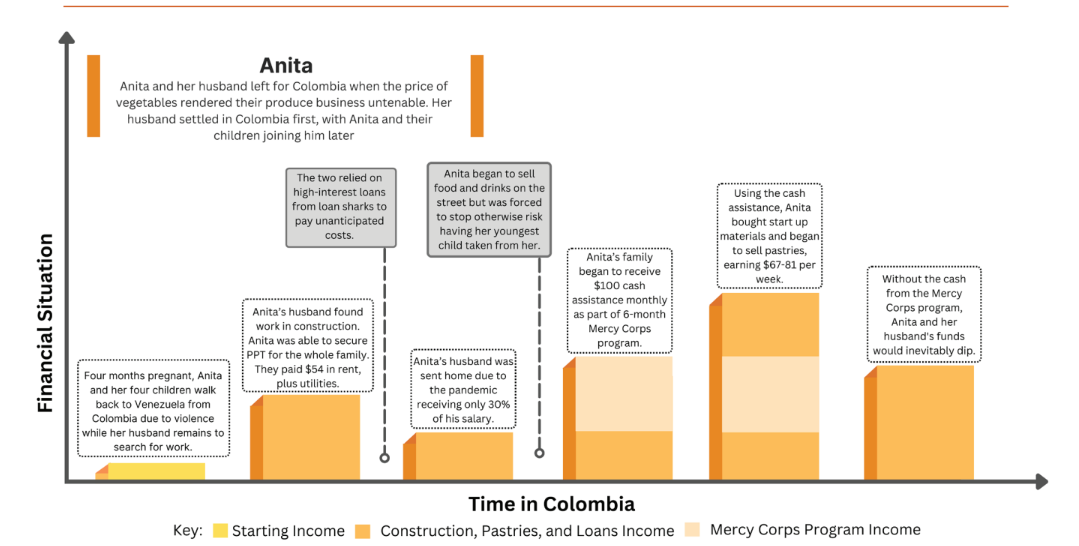
Two months later, in April 2019, Anita and her children traveled from Valencia, Venezuela to Medellín, Colombia, where her husband had secured a job working construction. When the family arrived in Medellín, they quickly settled in a house in the municipality of El Bello—high up on the hillside overlooking the city. They paid $54 USD in monthly rent, plus utilities. Anita’s fifth child was born in June 2019 and, owing to her husband’s stable construction job, the family decided to fully settle down in Colombia. A reliable stream of income meant that the family could cover large monthly costs, plus food and supplies for the five children. Anita deftly navigated the Colombian migration bureaucracy until the entire family obtained the Permission for Temporary Protection (Permiso por Protección Temporal—PPT), which enabled them to access the Colombian healthcare system and to formalized employment.
During this period of stability, Anita’s family was not struggling financially. Although they could not save money month-to-month, they were not living day-to-day. The family managed unanticipated costs by strategically using high-interest loans from paga diarios and, since Anita’s husband was working full-time, repayment was never a concern. When the pandemic struck Colombia in March 2020, however, Anita’s husband was sent home from work. He continued to receive 30 percent of his salary (a benefit of being formally employed), but it was not enough to cover the family’s monthly costs. To supplement the family’s income, Anita started to sell food and drinks on the street but was forced to give it up after an employee from Colombia’s welfare office threatened to seize her youngest child if she continued to bring him along.
During this time, Anita’s family started to receive cash assistance through Mercy Corps’ Ven Esperanza program, which provided $100 USD monthly. With this money, Anita paid rent and purchased food for the family, using the rest to buy small cake molds and ingredients to start baking. To diversify the family’s sources of income—and in anticipation of the end of the six-month assistance program—she started baking and selling 50 pastries weekly, for which she earned $67–81 USD. Each week, she would take half of the earnings and re-invest it to purchase supplies for the next week. At the end of each month, she had a profit of $108 USD.
The Mercy Corps assistance eliminated Anita’s daily stress about hustling to make rent. Without that added psychological stress, she had enough extra bandwidth to plan strategically for the future. With the baking business up and running, Anita’s husband had time to search for a more stable job, and he eventually secured a contract to work on a construction project. The contract, however, was only for a few months and its termination coincided with the end of the family’s Mercy Corps assistance in December 2021. As a result, the family faced a financial cliff, which was exacerbated when Anita could no longer afford to sustain her baking business, as saving for rent took priority over reinvesting in ingredients.
Hauling equipment and material up the steep alleys that flank Medellín has been the family’s only recourse. Yet, Anita and her family do not contemplate returning to Venezuela, nor continuing on to Peru to join her brother. If their weekly wages do not suffice to cover monthly costs, the family gets resourceful; “we’re always looking for some way to resolve the situation, like finding something around the house to sell [to pay rent].” And for food, the family often travels to collect discarded vegetables at the local market to ensure that everyone is fed.
Anita is hopeful that her husband will soon obtain a new construction contract. Her dream, she said with a slight smile, is to purchase a small house up in the hills and start a bakery. Restarting the baking business, she estimated, would only require $54 USD of investment, but absent access to seed capital or affordable credit, the family cannot pull the money together with their current wages.
Production of the Colombia financial biographies was made possible through our partnership with Mercy Corps, Colombia, as they were the beneficiary of this research. We extend our deepest gratitude to Mercy Corps for making this research possible.