
By networking with other refugees in Kampala, a Congolese couple is able to find temporary housing and work opportunities.
Isabelle and her husband fled to Kampala in 2012 after the M23 rebel group began taking territory in the region around Lake Kivu where they lived. They were able to take a boat from Bukavu to Goma, across Lake Kivu, then finally rode a boda boda (motorcycle taxi) for three hours from Goma to Bunagana, the last town on the Congolese side of the Ugandan border. Like many Congolese refugees, Isabelle and her husband simply walked across the border and presented themselves to Ugandan authorities in Kisoro, the first town on the Ugandan side of the border.
The border authorities weren’t much help, though, and nearby transit camps like Nyakabande had not yet been established.
“When you ask someone, they say the explanation of coming to Kampala was easier than coming to a camp. You have to take many roads to get to Nakivale camp. You need a car to Mbarara, then another car to another city, blah blah blah. But it is easy to get to Kampala; all cars are headed there.”
“Yes, at that time, the local police station could not help you. Only the Old Kampala police station was dealing with refugees at the time. So, we found a lorry. Someone was coming to Kampala with goods for the market, and he helps us. He said we did not have to pay after we explained to him our problem. Since he worked in Congo, I could speak to him in Swahili.”
“The driver left us just around Old Kampala. He took us as far as he could, and he pointed out the road to Old Kampala police station. At the police station, they were cooking some posho and beans — some lunch and dinner — for the officers. But when you are there, they give it to you. They give you some food if they have leftovers. We had to stay there overnight for one week to get papers. We slept on the veranda of the police station. Most of the refugees, when they are coming, they go there, so there were no problems staying there.”
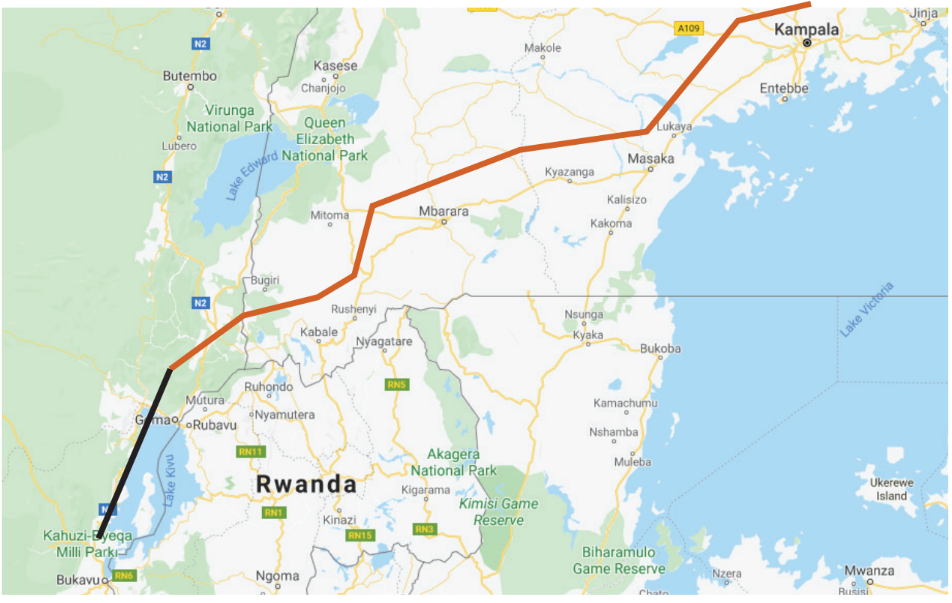
Isabelle and her husband relied heavily on Ugandan support in their initial displacement. Beyond the friendly officers who shared their meals with the refugees waiting outside, she also met a Congolese refugee who invited Isabelle and her husband into her home for three months.
“Most of the Congolese were coming there to the station for their papers. All of us Congolese were talking, and I got someone to help me get a place to stay for some time. She was also a refugee with her own problems, but she took us. She had a place on Entebbe Road, like Freedom City side [Katwe neighborhood]. She was a single woman who had kids. She had been in Uganda for eight years, I think.”
“We stayed for three months, and we got some food help from JRS [Jesuit Refugee Services]. We were new refugees, and they were giving out maize flour, beans, oil, sometimes sugar and rice. We would go to Nsambya to JRS once a month to get kilos of food to bring back to the woman’s house. I was pregnant at the time. I was tired. I didn’t have energy. I even fell down when she was there, and she bought me some food from the store to give me energy. I don’t keep in touch with her anymore because she is in America now, in Washington, DC.”
Isabelle’s husband quickly found work in the Katwe neighborhood, and they were able to save enough money to rent a room for the growing family.
“My husband started working with builders in that area, giving them blocks and sand and water when the builders were busy. He was not a builder – more like a laborer. The builders could make some money because they are skilled, but he could only make some 10 or 20,000 shillings ($2.71–$5.41) per day. He would go there each day and ask if they needed some help. After three months, we had saved enough money to pay the rent.”
“Rent was about 70,000 shillings ($18.95) per month, and then my daughter was born. We lived in that apartment for four months and then moved here to Nsambya. I found that there were more opportunities in Nsambya for both me and my husband. When I would meet with other Congolese, they would tell me that there were opportunities to learn English or learn skills in the centers in Nsambya. The NGOs know that most of the refugees are in Nsambya, so they set the centers here.”
NGOs like JRS, IRC, and YARID (Young African Refugees for Integral Development) provide essential skills training for refugees and Ugandans alike at their Nsambya locations. English language classes, business skills courses, and trade skill workshops provide some refugees with improved employment or income-generating prospects and help establish relationships among refugee communities and the Ugandan host population.
“My husband was still working with the builders and learning English when he had free time. Once my daughter was seven months old, I started learning cosmetology at JRS. The classes were 9:30 am–4:00 pm. They were long days for both of us, but I didn’t have a choice. The class lasted from February to October, and then I had an internship from October to December. I was not paid, not even for transport, for the internship. After the internship ended in December, they hired me, but I only worked there for about seven months. While I was there, I made maybe 400,000 shillings ($108.27) per month.”
“I found the internship on my own. I was just walking from salon to salon, asking for an internship. I left after the seven months because they were long days — 7:30 am to 7:30 or 8:00 pm. There are a lot of dangerous chemicals, like acids, in the salon. I had to pay a woman 2,000 shillings ($0.54) per day to take care of my daughter while I worked. The woman was not treating my daughter well, but also, I had been saving money while I was working at the salon, and I started my own business. I had learned tailoring at YARID and started a business selling kitenge and fashion. JRS does not allow you to go back to learn another skill once you have a certificate. You need to go out and find a job. So, I went to YARID to learn tailoring.”
“The tailoring business was for three months only, and then I got a job at YARID as an Assistant Trainer for the tailoring program. This was 2015. We worked almost as volunteers — we would get money for transport and some small tokens, but they also paid us a salary for a few months. The good thing about working at YARID was that, as a volunteer, they did not take all of our time. It was only 8:00 am to 2:00 pm, and I would make beadings [handbags] with my children at home, after YARID. I started at YARID in 2015 and left in 2016 after giving birth to my son.”
These days, Isabelle owns and operates a tailoring shop and sells brokered goods through social media, earning significant sums from both businesses.
“I have a tailoring shop with kitenges, kids’ clothes, beading, all of that nearby. I am teaching women in the shop with my machines to make clothes. I have had the shop for one year and six months. I am sometimes doing things online. I will post an item, like a phone, and people will pay for me to go get the phone for them. So, I need to take a loan to go buy the phone or the shirt for the customer because I do not have it on hand when I advertise it. Sometimes, the people don’t know where to find the thing — Kampala is big!”
“Both of [my businesses] make good money! It depends, though. Sometimes I get more orders for the online business and can make a lot there. And there are seasons for the shop — we are busy on holidays like Easter, Eid, Christmas, and before the new school term starts when they want a new uniform. But, in January and February we are bored. This month we are bored. There are no holidays, and no one is buying.”
Isabelle turned to her savings groups to find the capital to start her businesses.
“At first, it was difficult. When you are working, you have to buy your materials and machines one at a time. Before I left YARID, I had had the idea for a while, and whenever I could get some money, I would buy a machine. When I was ready to start the business, I already had three machines. I would buy them second-hand, and they would cost 200,000 shillings ($54.14) each. Rent for the shop is 150,00 shillings ($40.60).”
“I am in two savings groups. One is mixed, and one is only Congolese. YARID started a savings group and they called me and told me to join the group. When I was saving with that group, one of the group members saw that we were saving well and invited me to join the other group. I even found that the new group was more organized than the first, so I decided to save more in the new group than the one YARID started. In the YARID group, we save 25,000 shillings ($6.77) and 1,000 ($0.27) for welfare per week. In the other, “Neema,” we are saving 40,000 ($10.83) and 1,000 ($0.27) for welfare and 1,000 ($0.27) for social activities per week.”
“For me, I am not taking loans from the YARID group. Other people do, but they only allow you to take half of the money you have saved in loan. Also, the interest from your loan is divided among the whole group. In the Neema group, you can take a loan for up to double what you have saved, and 90% of the interest of your loan comes back to you at the end of the year, while 10% goes to the group. So, at YARID, if you stay in the group, even if you have not taken a loan, you can end up with more money at the end, but at Neema, the interest is your money. Sometimes I use the loans for my own businesses.”
Isabelle’s husband also found improved employment in Uganda, utilizing his newfound language skills and familiarity with Congo and Uganda to make himself indispensable to Congolese businessmen.
“He works as a broker for factories. For instance, the factory, Roofings, sells metal things like wire and metal sheets. Congolese may want materials from Roofings to go to Congo, but they don’t know about Roofings. Congo doesn’t have factories like Roofings, so they have to order from Uganda. My husband knows where Roofings is, and he has a wholesale account. You can’t buy from the company without an account. The Congolese send him money, then he buys the materials, puts it on a lorry, and sends it across the border.”
Outside of business expenses, the most considerable cost for Isabelle’s family is school fees. Isabelle has two children, and she wants them to receive the university education she never had in Congo.
“The boy will start daycare [Kindergarten] next year, and my daughter will start year one of primary school next year. The girl goes to private Kindergarten, which is 130,000 ($35.19) per term. Next year, she will go to another private primary, which is 200,000 ($54.14) per term.”
“It is not the best school she can go to, but it is the best for the fees I can afford. Because next year, I will have two in school. I want them to go to university, but they can choose their own careers. I am just [going] to support them, to pay their school fees, so they can do what they want.”