
Afghanistan to Greece: With young children, an illiterate woman flees violence only to face discrimination in the camp.
Farzana is Hazara, an ethnic minority that is vulnerable to violence in Afghanistan. Many Hazaras are Ismaili or members of the Twelver sect, Shia groups derided by other Shias, in a country that is predominantly Sunni. Often, Hazaras have features that easily distinguish them from other Afghans, making them easy targets for abuse.
“My name is Farzana. I come from a village in central Afghanistan. I am Hazara, a group that is hated and persecuted. I have never written or read a word in my life. I lived in a village of 28 houses.
Two years ago, the Taliban entered my village, making business arrangements with the landlords. The landlords grew rich but we did not. My husband had become addicted to the opium he harvested. He, his brother, and his mother would beat me when I could not care for all five of our children, milk our goats, and milk the landlord’s goats. He was too drugged to do his share of the work, but not too drugged to hit. My husband would go to town once a month to buy tea and sugar, but I never did. I was never allowed to leave the village. Soon, he became deeply in debt to the landlord, because of his addiction. After a time, he stopped going to town. We had no money to buy tea or sugar.
One night my husband announced that he would be receiving about $6,000 in afghanis, the currency of Afghanistan. I had no idea how much that was, just that it was a lot. I asked if it were a loan. He said no, he had gone to the landlord for a loan and the landlord had said, ‘I will not lend you any more money, but I will pay you $6,000 to marry your daughter.’ My husband agreed. Our daughter was eleven years old.
It is custom in our village to prepare a wedding feast for the engaged couple. I had only one week to prepare. The feast would be at our house where the mullah would come and wed the landlord to my daughter. It is also custom for the wife to join the husband a week later in his home and be welcomed by a second feast. The night of the wedding came. I cooked all day. The mullah came and performed the vows. Later, I could hear my daughter screaming. She broke the door of the bedroom and ran into my arms and cried, ‘Rescue me!’ Before dawn I heard the landlord leave for his home. I gathered all five children, tucked as many leftovers in my clothes as…
I could, took the $6,000 from the pocket of my husband (he was in a stupor), and ran. We scrambled for hours through the wild. I found the road and eventually the town and a taxi. I told the driver to take me to my mother’s town and he did.
“When my mother saw me, she said, ‘I must hide you.’ Your husband and the landlord will come looking for you here. She placed me with her cousin. Her cousin traded with businessmen in Pakistan and knew the roads well. The next day he drove the children and me to the border where we switched cars, then drove to Quetta. In Quetta I found work as a domestic cleaner. My patron was a professor and very kind, often buying gifts for my children. One day I bought a mobile phone, my first. My daughter showed me how to use it and I called my mother. My mother said, ‘They are coming to kill you. You are not safe. You must go to Europe.’
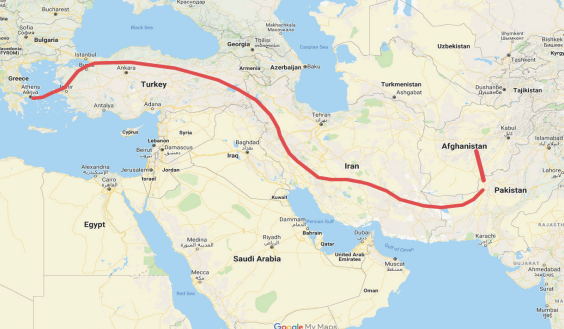
“I did not know what Europe was nor where it was but I knew I had to leave. My cousin found an elder smuggler in Quetta. We paid a saraf there who took my money for safekeeping. As I would reach a waypoint along the route through Pakistan and Iran, with the help of my daughter, I would text the saraf a four-digit code and he would release a payment to the elder smuggler. Then a new local smuggler would show up and take us to the next waypoint. Across Iran we often traveled like this, passed from smuggler to smuggler. We traveled with other Afghan refugees. We would be jammed in a car, or in the back of a truck.
“Even though the local smugglers were to be paid by the elder smuggler I was often harassed to pay more. So, I pretended to be married to one of the Afghan men and he would deter them from extorting more from me.
“Like this, step by step, we traversed from Iran to Turkey, over the icy Zagros mountains that took 20 hours to cross. Then we faced the chaos of the sea from Turkey to Greece—a sea where I saw death.
“In Turkey, with the help of my mother’s uncle and by asking around, we left for the coast. We traveled 80 of us in a small raft. I felt certain we were going to die. We left at midnight and arrived at dawn on the island. A Greek man found us as he was walking along and alerted the police who came to us within an hour. We were completely soaked to the bone and for two weeks, did not have a change of clothes. We were told at the camp: first Syrians, then you. We stayed in a large tent, filled with angry men throwing stones, breaking glass. The only protection we had was the blankets we hung to form walls.
“Now in this camp [on the mainland] here in Greece I still have some of the money from my husband’s sale of our daughter to the landlord. I am saving it to move north. My daughter, now 13, has reached Holland and I want to join her. I am able to manage on the monthly cash grant that I receive from an NGO. Many people in the camp complain that it is not enough but I am able to stretch the entire amount till the end of the month. I buy a slaughtered lamb and hang it in the hallway to dry. Every day I tear off pieces of it, wash it, and then simmer it in oil with tomatoes, onions, and herbs. My children eat meat, rice, and vegetables every day.
“As soon as our card is loaded with cash, I give the card to an Afghan friend who travels to a ‘machine’ in Athens. He knows the PIN numbers. He stands at the machine and asks a Greek passerby to help him. My friend says he does not understand the letters on the ATM screen, the direction of the language on the screen, or the language itself. He is better off asking a Greek. He then takes the money and the receipt and brings it to me. I can’t read the receipts but I save them and ask my daughter to check the receipts against the money. We had only one problem, once. My Afghan friend went to the machine and it rejected the card. The NGO came to the camp to help us. They took out their computers and saw what had happened. They fixed the problem right there, giving me a new PIN. This was the only camp where I did not hear, ‘First we help Syrians, then you.’ I matter here.
“But, I do wonder what else the NGO could see when they look at their computers. They could see my name and how much money was in my account, but I wonder what else and who else can see what they see. I worry still that my husband will track me down.”