

A Venezuelan woman uses her close-knit family to manage finances in Colombia.
As the oldest of ten siblings, Ariely’s life has always revolved around her family. It came as no surprise that her priority upon arriving in Cartagena, Colombia, was helping the rest of her family join her. Eventually, they succeeded in reuniting nineteen family members, living in three apartments on the same street. Having a large family comes with many expenses, but it also allows them to tap into multiple income sources and lines of credit. Financially, Ariely and her family barely get by each month, but the mental and emotional support she feels from being with them has helped her maintain a positive outlook on the future.
Without a doubt, the grounding force in 32-year-old Ariely’s life is her family. Since fleeing Valera, Venezuela in August 2018 and arriving in Cartagena, Colombia, so many things have changed. She had to abandon her fast-food business and the home she bought in Venezuela. Her baby son experienced a critical blow to the head and underwent surgery. And tragically, two of her siblings have since passed away. The grief speaking with Ariely, one cannot help but feel her resolve. She believes that life is going up from here and that her family will “make it,” because they have each other. Surrounded by eighteen family members on the same block, Ariely is emotionally bolstered and resilient, despite facing prolonged unemployment and struggling to make ends meet.
Back in Valera, Venezuela, Ariely worked for three years as a waitress. Her boss invited her to participate in a cooperativa, or savings group, with nine other female coworkers at the restaurant. Each week they each contributed the same amount to the collective pot, and each week a different group member took the pooled money home. Ariely stored the cash in her home, and eventually saved up enough to buy her mom and younger siblings a house on the same street in Valera as her and her husband, Rafa. Next, she and Rafa saved up for a motorcycle for his work as a moto-taxi driver, as well as a food stand. Lacking access to bank credit, they worked as a team, combining Ariely’s cooperativa savings, her severance pay when she left the restaurant job, and Rafa’s savings. By 2016 they had enough savings to open their own fast-food business.
At first, their business did well. But, when the Venezuelan economy started tanking, things took a turn for the worse. Someone stole their motorcycle, which delivered a double-blow to their financial health, as it was necessary for Rafa’s moto-taxi work as well as their fast-food deliveries. Eventually, they could no longer afford inventory for their business.
Ariely and Rafa also began to worry for the health of their two young sons, as food became increasingly difficult to afford. In late 2017, their seven-month-old fell off the bed and hit his head. He needed an operation to repair his skull. They scraped together their remaining savings and sold products that a neighbor had gifted them. With that, they were just able to afford the surgery that saved his life. This expense completely wiped them out financially, so Rafa left to find work in neighboring Colombia. He hoped to bring Ariely and their sons across soon.
Rafa arrived in Cartagena in May 2018 and crashed on a family friend’s floor. As soon as he could get together a small sum of money from street sales, he found his own apartment. Three months later, Ariely followed, bringing their one and six-year-old sons with her. They crossed the trocha, or informal border crossing near Maicao. Strapped for cash to pay the multiple fees to those guarding the trocha, Ariely hit a stroke of good luck when she ran into a guard from her hometown. He let her pass through without paying. By the time Ariely arrived in Cartagena, Rafa had connected with neighbors and a local church, who donated clothes and kitchen supplies to them.
Slowly but surely, Ariely and Rafa worked to bring other family members to Colombia. Ariely remembers how painful it was to be separated from her mom, Mamá Anita, for many months. Eventually, twenty members of their family were reunited in Colombia (one of whom has since passed). And just like in Venezuela, they now live next door, in nearby apartment units. In the beginning, everyone pooled their income towards renting the same crowded unit. Now, four years after first arriving in Colombia, Ariely and Rafa have moved into their own unit and are able to cover these costs separately.
Household 1: Ariely, Rafa, and their three sons, one of whom was born in Colombia, make up a five-person household. They currently rely solely on Rafa’s income as a moto-taxi driver. He makes $24 USD per day, half of which is profit. Of the other $12 USD, $5 USD goes towards gasoline and $7 USD goes towards the daily cost to rent the moto. He earns around $244 USD.
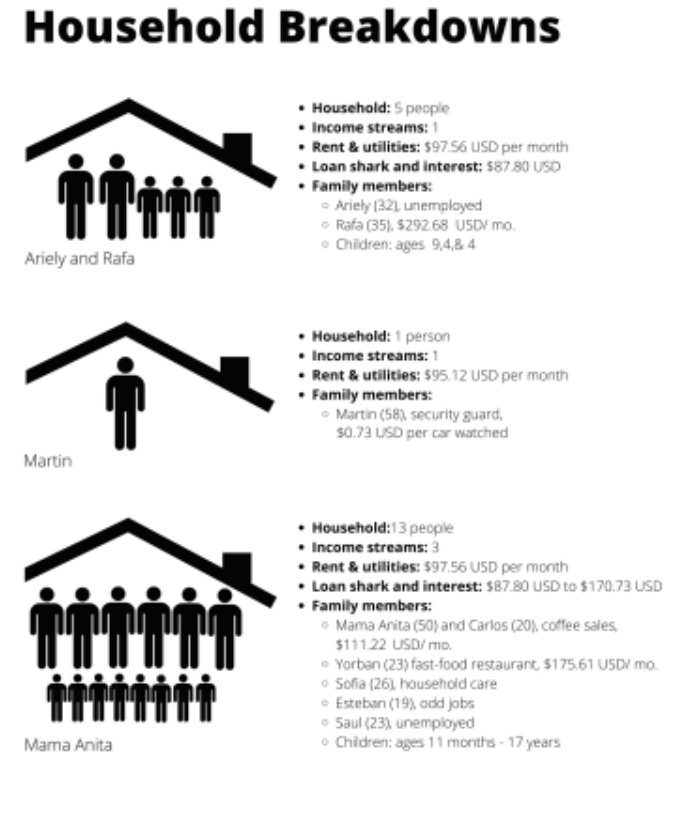
Household 2: Right below Ariely and Rafa’s apartment, Mamá Anita heads up a household of thirteen: six adults and seven children. With more people comes more income streams, but also much higher costs, particularly food and school costs for the seven children. Mamá Anita and one of Ariely’s adult brothers, Carlos, sell coffee on the street, making about $7 USD in sales per day between the two of them. Of that, $2.70 USD is invested into their product inventory, leaving them with a daily profit of $4.50 USD. Yorban, one of Ariely’s brothers-in-law, works at a fast-food stand, earning $7 USD per day in wages. Of the other three adult family members, 26-year-old Sofia heads up making meals and caring for household needs and 19-year-old Esteban pitches in on household costs if he can. Twenty-three-year-old Saul has Down Syndrome and tends to remain at home. This household earns around $239 USD per month (Coffee: $4.60 profit x 20 working days = $92; Fast food: $7.30 wages x 20 working days = $146).
Household 3: Next door, their stepfather, Martin, has a private room. He pays $3.20 USD in rent per day for this housing, which comes out of his daily wages guarding parked cars overnight. He makes $0.49–0.73 USD per car that he watches. He also watches over the building where he lives, which is nearby, and in return, his landlord makes him a meal. Ariely explained, “The owner gives him dinner, and he takes care of her home.” Martin earns around $183 USD per month.
Despite differentiating big costs like rent between these different households, Ariely and her extended family still often pool resources when needed. For example, when cash is tight, they work together to buy food on credit, or comida fiada, always doing so at the same corner store. The owner, with whom they’ve been able to maintain a good relationship, lets each person buy up to $12 USD worth of food at a time on credit, and they have to pay it back within five days. Whenever someone can’t afford food out-of-pocket, “the family member with the lowest pending balance owed to the owner will buy the comida fiada.” Ariely explained, “If one person eats, we all eat.”
Another way that their family taps into informal credit is through paga diarios. These local loan sharks charge sky-high interest rates, often ranging between 20 to 30% and allow borrowers to make small, daily payments, usually around $5 USD per day. Ariely’s household takes out a $73 USD loan each month and has to repay a total of $88 USD, and Mamá Anita’s household often takes out two such loans, needing to repay a staggering $176 USD over the course of the month. Ariely’s family relies heavily on these loans to get by and reports a good relationship with their paga diario. “The paga diario saves us when it comes to rent. And if we can’t make a payment one day, he doesn’t get mad.” Although they fill an important need for quick cash, Ariely also feels trapped in debt. “Each month, as our rent due date approaches, just as we’re about to finish paying off last month’s loan, we have to take out a new loan to pay for rent again.”
Although Ariely and her extended family support each other by splitting costs and accessing various credit sources, sometimes they simply don’t have enough to go around. Two years ago, one of Ariely’s sisters, Eliana, fell ill with cancer. Lacking migratory status, Eliana couldn’t access Colombia’s state-subsidized health insurance. Despite their best efforts to pool resources, her family couldn’t afford the chemotherapy treatments that she needed. Tragically, she passed away, a sorrow that Ariely continues to live with.
Today, Ariely is unemployed and struggling to find a job. She received $90 USD per month for six months through Mercy Corps’ Ven Esperanza cash assistance program earlier this year, which really helped her to cover basic needs. She was hoping to put some of the funds towards buying assets to start a small food stand business like she had in Venezuela, but she ended up needing to use all the cash assistance to cover food and rent.
Despite these many layers of challenges, Ariely manages to maintain a bright outlook on the future. It’s clear that having her family around bolsters her not only economically, but emotionally, too. “I’m not leaving for another country to start again from zero,” she said. “What I hope for is to have our own little house here and our own business.”