
Formerly a social worker, a South Sudanese woman struggles to earn a living on her own in Kampala and worries about educating her kids.
Grace had a good job in South Sudan but has struggled to build a life in Uganda. Grace lost her husband during the war (losing a significant potential source of income) and was unable to save once the government ceased paying salaries in 2017. Her children attended both private and public schools in South Sudan. As violence resumed, she also worried about the educational opportunities for her kids. She worried that private schools cost too much. She earned 1,500 South Sudanese pounds per month ($11.52 now, but much more then, before significant inflation), and school fees for her children averaged 500 pounds ($3.84 now) per term when she left in 2017.
“I was a social worker in South Sudan since 2004. I worked with children who had been separated from their parents during attacks in the war, and many of them had mental issues and trauma. The children would stay at the Center for a month before we could reunite them with their parents or closest family. It was a good job. I made 1,500 South Sudanese pounds ($11.52 now, but worth much more then) per month, but then the government stopped paying salaries for six or seven months. And then the war came.”
Grace relied heavily on familial connections to get her to Uganda and smooth her transition once she arrived in Kampala. Her brother in Juba paid her way from her home town to Juba. That same brother took care of her children in Juba for three months before joining her in Kampala. Her sister gave her and her children a place to live in Kampala for a year.
“My brother lived in Juba at the time and he sent money for me to leave with the children [Western Equatoria] to Juba. He sent the money by Eden Bank [a South Sudanese bank], and then we stayed with my brother for seven days in Juba. I went on to Kampala alone and left [the five] children to stay with their uncle in Juba. I had an older sister who lived in Kampala. I met a member of the South Sudanese Red Cross on my way from Juba, and she paid for my bus tickets and visa to Uganda.” Grace’s sister played a vital role in her journey to Uganda.
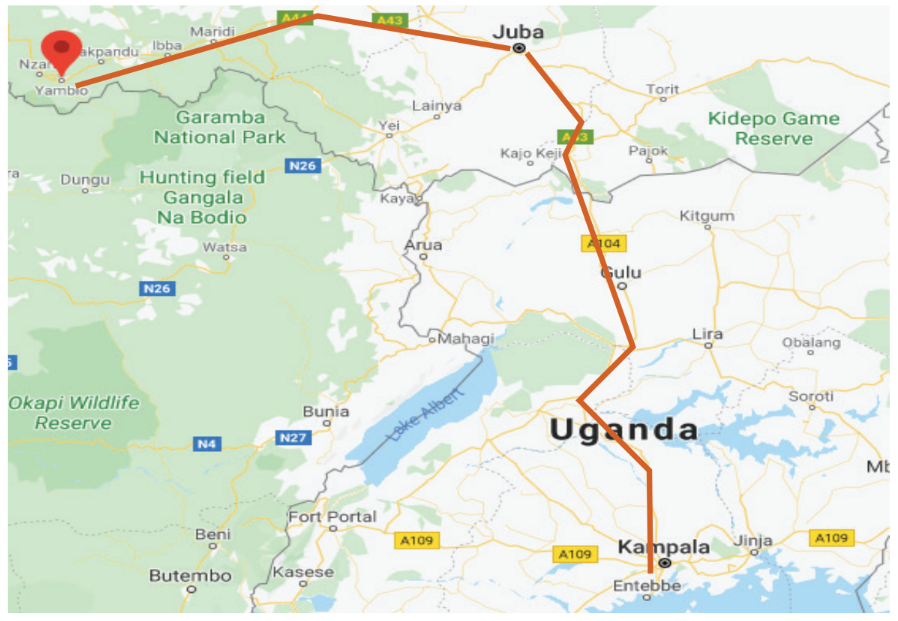
“I lived with my sister in Batata [near Freedom City] for almost a year, and after three months, my children arrived from South Sudan, so we were squeezed. Their uncle in South Sudan paid for them to take a bus from Juba to Kampala. After a few months, we were too squeezed in my sister’s home, so we moved here [to Masaya] to be closer to the Church.”
“My sister has an older daughter who lives in Juba. She works for World Food Program and sends money to my sister in Kampala when she can. It’s not enough for rent, though, maybe food, but it’s enough to help. The daughter sends it by mobile money.”
Perhaps the only figure more important to Grace’s life in Uganda is the late Archbishop Peter Munde, a prominent member of the Anglican Church. Anglicanism is one of the primary religious denominations in Western Equatoria, and Archbishop Munde was instrumental in not only supporting South Sudanese refugees in Kampala but also in shepherding groups of South Sudanese across the border to Uganda. We even heard stories of Archbishop Munde bargaining with rebel leaders to secure the release of child soldiers into his care.
Archbishop Munde and his wife lived in a large home in the Makindye Division in the southern outskirts of Kampala. The Archbishop and his wife cared for dozens — possibly hundreds — of South Sudanese refugees. They paid school fees, medical fees, rent, and even put up more than a dozen South Sudanese children and teens in their home. Archbishop Munde passed away in October 2018, and his passing has adversely affected many of the South Sudanese respondents we interviewed.
“Rent is 400,000 shillings ($108.51) per month, and I have no job in Kampala. I have one friend in Juba who would send money via mobile money to me once every two months to help with rent. She would usually send about $100, maybe with $20 or $30 on top to help with food or school fees. Bishop Munde would help, too, but he has been dead since November, and the new bishop does not arrive until later this month.”
Grace briefly established an interesting and lucrative business while in Kampala. Grace would send secondhand clothes from Kampala to a friend in Juba, who would resell the clothes there and share the profits with Grace. Second-hand clothes are preferred to new clothing because they tend to be made of superior material and don’t deteriorate as quickly. Grace was able to make enough money to cover rent for a few months through this venture, but after an indeterminate amount of time — likely four or five months — her friend stopped sending money back to her in Kampala and the enterprise ended.
“The hardest time in Uganda is right now. When there is no money, they cut our water and electricity, so we have to drink from the stream. We have been drinking from the stream and without food for two weeks now.”
Like some other South Sudanese we met in Kampala, Grace would prefer to be living in a camp setting over her current situation in Kampala. She initially headed to Kampala because of her sister. Now that she cannot afford rent, school fees, or even utilities and food, she would prefer to live in the camps but cannot afford the transportation fees to reach distant Bidi Bidi.
“I tried to go to Biyale earlier this year, but the camp has been closed since last year. I want to register the children in a camp so they can receive primary school, but the transport money for all of us is too much. It would be 30,000 UGX ($8.14) per person for us to take a bus to Bidi Bidi [the closest open camp], and there are six of us. So, for now, I am stuck.”