
A gregarious university student goes to study in a small town in Tunisia on a scholarship and gets by through the power of building networks.
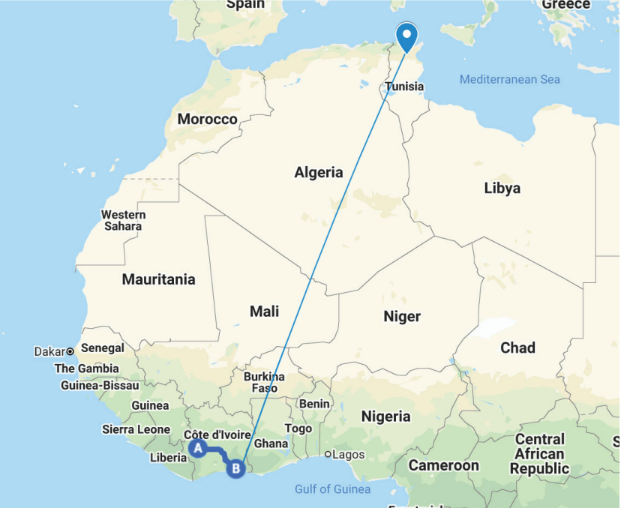
When he wins a government-funded scholarship, Malik leaves his Ivorian university and moves to Tunisia as part of a wave of Sub-Saharan African students. Malik must find creative workarounds to afford life in Tunisia and is forced to navigate living in his new community as an outsider.
I can’t help but notice that Malik seems particularly alert. “I don’t want to go through crowds. I don’t like it,” said Malik. Walking with him, I notice for the first time how Malik walks around town: avoiding crowds, moving fast, speaking quietly. After a few weeks, I realize that it’s a pattern, not only for him but for most of the black students we run into in this tiny town.
We sit at a café and Malik continues, “People have a tendency to stare at you as if you came from a different world. It complicates everything. Sometimes they can’t tell whether I’m a black Tunisian or a foreigner. They always ask me; they want to know if I’m like them or not. One time, I got into a cab, and I was called ‘Kahla’ [a derogatory term for brown and black-skinned Tunisians and foreigners]. That really hurt. When I insulted him back in Arabic, he apologized. If you can show them you understand them, they change. But I can’t show them I understand them just while walking down the streets, without a real exchange. So, it’s better they don’t see me.”
Malik was born in a village eight hours from Abidjan in Ivory Coast. His father studied Arabic literature in Saudi Arabia, Sudan, and Morocco and then returned to Ivory Coast to teach Arabic and Theology. Malik’s mother is a trader who sells rice and peppers. She is one of the richest women in the village. Malik has three older brothers: one living in Abidjan and working as a taxi driver, another living in France, and a third who works for a bank in Senegal and manages the family’s finances.
Malik is the youngest. He started selling phone credit by the time he was eight years old. Malik’s brother bought him a phone and money to buy credit to resell, and Malik was allowed to keep the profits. He explained, “If he gave me $15 and I made $25 from selling the minutes, I’d give him back the $15 and keep the extra $10. I could buy whatever I wanted with that money, so I started feeling financially responsible from a very young age.”
Malik spent summers studying in Abidjan with his brother who paid for Malik’s school fees and had high expectations for his academic success. “He was really tough on me. I had difficulty writing and speaking in French, so he wanted to correct me. As my results in school improved, so did our relationship,” Malik said.
When Malik was around fourteen, he and his parents moved to Abidjan. Malik made money by running errands, like grocery shopping for his older brother, who let Malik keep the change. “I was very young, but I was smart and made even more money than some older people. I was just self-confident, so people would trust me with their money,” said Malik.
His brother left for Senegal and began sending money through Wari, an international money transfer service. His brother typically sent $687 per month. Of that, $350 was sent to their mother, $170 to their uncle, and Malik kept the rest. Malik explained, “That’s how I learned to manage money. That’s how I got where I am in Tunisia.”
During his final year of high school, Malik was admitted to an IT and Communications program near Abidjan but continued applying to opportunities abroad. In early September, Malik received a scholarship offer from the Ministry of Foreign Affairs in Tunisia. Within two weeks, he quit his university in Abidjan and left for Tunisia.
The ministry had recommended booking flights through a travel agency for $515. Instead, Malik asked his friends to search for a cheaper flight, and his brother in Senegal sent money through Wari to purchase the ticket. He also got vaccinations and winter clothes. In total, Malik spent $860. The ministry advised students to expect to pay an additional $110 in monthly expenses, so Malik’s parents sent him with $515.
One of Malik’s first goals in Tunisia was to move out of the student dorms. Even though students could stay in the dorms for free, Malik estimated that 80% of male students from Sub-Saharan Africa move out due to the poor conditions. Malik befriended a man working in the dining hall. He had a motorcycle and drove Malik around until he found an apartment. “Thanks to him, I found a home. I sensed he was a good man. I always fall on good ones.”
He moved in with three other Ivorian students. “It cost us $100 a month. We stayed there for two years, but last summer we had to move out. The landlord had raised the price to $150, which was insane!” The owner complained to Malik that the students made too much noise and scratched the paint on the walls. “To be honest,” Malik continued, “I don’t think we make more noise than Tunisians. But, I remind myself that I’m not in my country. It’s like I have 90% of my freedom, not 100%.”
Scholarship money was always late, according to Malik. The university sent it through the post and the students retrieved it by showing their student ID and a unique code. “Classes are supposed to start in September, but we get our first transfer early November ($160), then in December ($80), then in March ($120), and finally in June ($80),” Malik explained. His brother in Senegal also sent money through MoneyGram, usually $70 each month. When he needed more, Malik borrowed $5–$10 from his friends. He also lent up to $35 to his friends, who reimbursed him within a few weeks.
Malik tried to save when he could. “My policy here is to always plan for the unexpected. Whenever my brother asks me if I still have money, I usually pretend I’m out. Last year, I saved $340,” said Malik. He found it difficult to save during his third year at university because of a mandatory unpaid internship, though. “I have to spend on phone credit, which is about $3.50 to $5 a month, and transportation to Tunis is $8 roundtrip,” said Malik. He asked his brother to increase his monthly transfer from $120 to $175, arguing that the value of Tunisian currency had dropped while the cost of living increased.
To save money, Malik decided to invest in a quality phone with $340 of his scholarship money. He said he would have spent the money if he hadn’t invested it. Once, his phone was almost stolen on the metro, so Malik began traveling by taxi, which costs $5, instead of the $0.25 metro fare. To minimize spending, he cooks instead of eating at restaurants and buys all of his groceries at the beginning of the month. “I buy food for $17 in big quantities and I cook with it for two weeks. I spend around $35–$50 on food per month. It’s cheaper than eating out or taking a cab to go to the student cafeteria,” said Malik.
According to Malik, government regulations have made it nearly impossible to send money back to his family in the Ivory Coast through formal services like Western Union. Tunisia limits money sent out of the country, so Malik uses an informal money transfer method called “Orange Money.” If Malik wants to send money to his parents, he asks his Ivorian friends if they are expecting money from their parents. Malik gives his friends the money he was going to send his parents, and the friend’s family sends money to Malik’s parents. “I didn’t know I could do this until very recently! Otherwise, I would’ve sent the money back home, of course, rather than buying a phone!”
Students leave town in June to find jobs, but Malik prefers to stay and live off the money his brother sends. “We don’t really have the right to work here. It’s all informal, and your contract has no value,” Malik explained.
During his first summer in Tunisia, Malik befriended the owner of a local photocopy shop. The owner was overcharging students, so Malik negotiated with him. The owner liked Malik and gave him a discount. When he learned about Malik’s IT experience, he offered him a job. At first, Malik wouldn’t take any money from the owner. The two became friends, and Malik began fixing laptops at the shop and putting music and movies on customers’ phones and hard drives. “By establishing this relationship, I knew I’d get some discounts. I never had to pay for photocopies. So, at the end of the day, it was in my best interest,” Malik explained.
His relationship with the shop owner offered him a flexible work schedule. He could choose his own hours and wages. “[The owner] tells me to just take it from the cash machine. I take $3.50 to $5, maximum of $6.75 [for five to six hours of work],” said Malik.
Once, Malik was supposed to deposit cash into the shop’s bank account and wasn’t given a receipt by the banker. The shop owner’s wife accused Malik of stealing. They returned to the bank with the shop owner and his wife. “I was really scared that for some reason the banker would pretend I was lying, so I took $30 in my pocket, and I was ready to give it, just in case there was a problem. You know they could arrest me for this?” The bank confirmed the deposit, and the shop owner’s wife left without apologizing.
Malik is now applying to master’s programs in Europe. Even if he’s admitted, he plans to remain in Tunisia until classes start because the cost of living is cheaper. He doesn’t plan to return to the Ivory Coast. He says there isn’t as much opportunity. “The only day I’ll go back is when I’m absolutely certain I can get an amazing job there,” said Malik.