
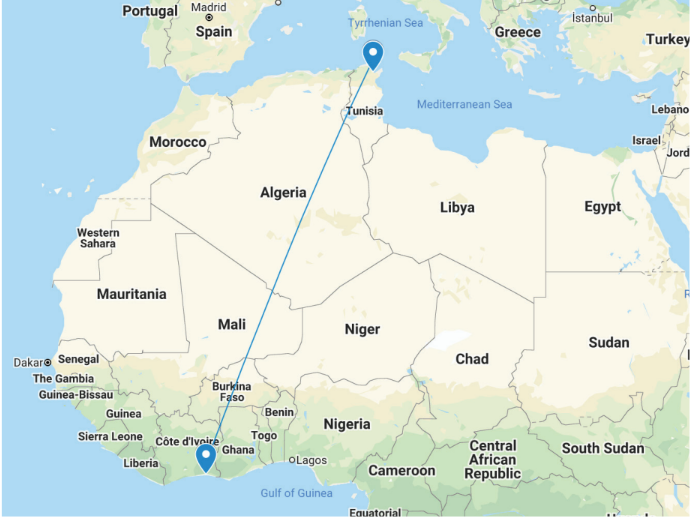
A middle-aged couple leaves their family in the Ivory Coast to seek better work opportunities in Tunisia, with the hope of sending money back home.
Although their financial situation is better in Tunisia than back home, Claude and Victoria, a couple from the Ivory Coast, struggle to make enough money to send back home with the working conditions and discrimination they experience. Compared to their expenses, the earnings they make are only enough to support themselves.
It’s been two years now since Claude and Victoria migrated to Tunisia from the Ivory Coast. Back home, Claude had a variety of jobs, including teaching at a private school, while Victoria worked in the restaurant industry. Eventually, they began to work alongside one another, first operating a “cabine telephonique” (a telephone kiosk) before opening a drinks shop together. However, when the civil war worsened in 2010, they had no choice but to shut down their shop.
As things did not improve, Claude and Victoria felt they had no choice but to leave behind their family to seek better work opportunities. With the help of Claude’s younger brother, who was working and living in Tunisia, they left the Ivory Coast.
Within his first week, Claude got a job as a dishwasher in a restaurant where his younger brother worked. Washing dishes six days a week for eight hours each day, he received $156–173 per month. Shortly after, Victoria arrived, joined him at the restaurant, and found additional work housekeeping at a French couple’s home on weekends. All of their work was under the table and after three months, when the seasons changed, there was less business at the restaurant. Claude and Victoria were without their primary source of income and left to continue looking for work.
However, they were not so concerned with finding new employment, since work is never that hard to find, as they are preferred by many employers over Tunisians, who ask for more money and do not work as hard. However, Claude and Victoria realize that their status keeps them victim to exploitation. Victoria swaps stories with other women from the Ivory Coast living in Tunisia, many of whom lament about how underpaid and overworked they are, feeling like they are tasked with a job meant for two people.
One of Victoria’s friends shared how she initially cleaned one floor of a family’s home and then was made to clean two floors, as well as another relative’s home. When she complained, her employers emptied her room, fired her, and withheld her final payment. Many of her friends have also fallen into a “sous-contrat” agreement (“under contract” – an agreement typically made before traveling from one country to another) and are bound to their employers’ demands with little way of getting out of their situation.
“I have a good friend back home who called me the other day to ask me if her sister should come. She had heard about the sous-contract offer. I told her, ‘No, no, don’t let her come. It’s better she stays at home.’ In Ivory Coast, people are starting to realize this, and people are trying to spread the word.”
With the money they can make, Claude and Victoria can afford to live modestly on the first floor of a larger house, which they share with a flatmate to save money. They feel lucky because their landlord is fair and doesn’t take advantage of them, unlike many of their friends who speak of their own situation. Other landlords often charge random amounts for bills, including many of their own expenses like washing machine use and air conditioning, which their tenants do not use. Claude and Victoria have their own water meter and are not subject to sharing costs with their landlord.
Although the cost of living is manageable with the money that Claude and Victoria collectively make, and better than if they remained in the Ivory Coast, saving is still a challenge. Food is their main expense, followed by electricity, water, and transportation. Although they are luckier than most with their utilities expenses, transportation remains difficult, as taxis are very expensive and drivers increase their meter prices upon seeing Black customers.
Whatever extra money they have, they send back home to provide for their elderly parents as well as their children. However, this can become a risky process because they must trust someone to travel with the money back home. Sometimes, they give money to Ivorian students in Tunisia who are waiting to receive money from their parents in the Ivory Coast. The parents will then transfer money to Claude and Victoria’s relatives.
Claude and Victoria also live in fear because of their legal status in Tunisia, which costs them $28 in monthly debt for being undocumented. This debt can only be paid upon departing the country, which makes them reluctant to leave.
“If we could pay this penalty on a monthly basis, it would really be life-changing and a big relief. It’s really, really worrying. We had a meeting with people from IOM in a nearby neighborhood three or four months ago to speak about it. They gave a training on working conditions, access to justice, and their services. We spoke about this issue of the document penalty, but they didn’t do anything.”
While they remain in Tunisia, physical and verbal aggression is a daily occurrence for Claude and Victoria. They are subject to racial slurs like “Guera-Guera” (which means “monkey” in Arabic) and they risk their possessions getting stolen. Claude mentions being robbed at night by three young men. “They took my phone and some money and paper, but thank God, I didn’t have my passport on me, so I just let it go. I didn’t even think of speaking to the police.”
Despite feeling marginalized, they try not to pay attention because they can’t go to the police without fear of being questioned and risking their residency.
When they feel more comfortable, they hope to send their son to Tunisia to be with them, although they know that the language barrier and cost of schooling will be a challenge. “It’s been two years already. Our child keeps crying on the phone saying he wants to come here. We want him to first come on a holiday and then, if the school accepts him, we will see. We’ve made an application for him at an international school that teaches in French to see if they would take him, and we’re waiting for the response.”