

A couple looks for opportunities and waits for some good news.
Felicia moved to Colombia in 2018 after graduating high school in Venezuela. Her partner, Daniel, had made the same journey two years earlier right after he got his high school diploma. He had established himself by washing windows at stoplights in Medellín, so when Felicia arrived, the couple continued to work in this unique economy while also struggling to secure stable housing. Stable shelter became even more of a priority—and a challenge—after the birth of their daughter in 2020. Their monthly strategy for saving up rent money, as well as managing credit from loan sharks, landlords, and the corner store, enables the couple to get by.
In Medellín, Colombia, stoplights create a micro-economy. Armed with spray bottles and squeegees, or just a simple rag, young Venezuelan migrants like Felicia and her partner, Daniel, wash windshields as drivers wait for the lights to flicker from red to green. “At our stoplight, we work in pairs,” she tells me, “and all profits are split.”
Whoever secures the consent of the driver receives a sort of ‘finder’s fee,’ Felicia explained; if a pair receives $0.12 USD for their efforts, the ‘finder’ receives $0.07 USD, while their partner keeps the remaining $0.50 USD, although there is no set price for the service. Felicia and Daniel, however, prefer to pool their earnings, which typically leaves them with a daily profit of $16 USD—just enough to purchase food for themselves and their two-year-old daughter.
When Felicia arrived in Medellín in 2018, she was eighteen years old. After a brief stint at nursing school in Venezuela, she decided to leave for Colombia because the cost of transport had rendered commuting to school in Venezuela unfeasible. When she arrived, Felicia moved in with Daniel, her high school sweetheart, who is two years older and had traveled to Medellín straight after graduating high school in 2016. “The first day, I stayed in the room alone while he went out to work,” Felicia said. For two years, Daniel had washed windows nearly every day and, without any previous professional experience of her own, Felicia soon joined him.
For her first two years in Medellín, Felicia and Daniel lived in a small room, where they paid $4 USD daily in rent. In late 2019, however, after discovering that she was pregnant, Felicia and Daniel moved into a house along the hillsides of the city, where rent was $94 USD, plus $19 USD in utilities each month. By washing windows daily, the couple was able to cover the monthly rent, although they occasionally relied on one of Daniel’s friends, a loan shark, for high-interest (20%) loans to cover unanticipated expenses or rent when they were short. “My partner has a good relationship with him,” Felicia emphasized, insisting that despite the usurious terms, the couple never worried about the consequences of defaulting; “If we can’t repay, Daniel talks to the loan shark, and he gives us more time.”
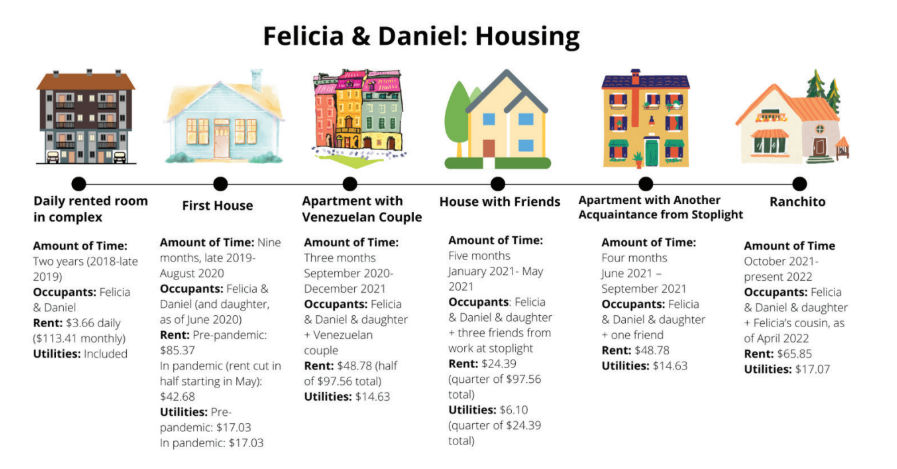
With the onset of the COVID-19 pandemic in early 2020, Felicia and Daniel received a rent reduction that required them to pay only $66 USD monthly, including utilities. But the birth of their daughter forced Felicia to temporarily stop working, so after a few months, the couple could no longer afford the house—even at the reduced rate. “We moved into a small apartment with another Venezuelan couple that we met working at the stoplight,” Felicia said, “and each couple paid half of the rent.” Felicia and Daniel paid $54 USD in rent, plus $16 USD in utilities, but after the landlord decided to sell the house, the couple soon moved again. Next, they lived with another set of friends and paid $27 USD of the $108 USD in rent, before a fall out between two of the roommates forced them to relocate.
Then, they moved in with yet another acquaintance from work and paid $54 USD in rent, plus $16 USD in utilities. After four months there, they began looking for a house for themselves.
After a chaotic year of housing instability, and the birth of their daughter, Felicia returned in 2022 to work at the stoplights, and the couple began renting a small ranch house in San Javier for $73 USD monthly, plus $19 USD in utilities. The availability of childcare dictates Felicia’s work schedule because the couple’s daughter (who is a Colombian citizen and therefore eligible for Colombian social services) attends free daycare from 7:30 am to 3:30 pm daily. Thus, Felicia and Daniel typically work at the stoplight from 8:00 am to 3:00 pm, allowing for the thirty minutes it takes to travel between the daycare and their intersection closer to the center of the city. “Periodically we have to work late,” Felicia said, referring to the final week of each month before rent is due, when the couple extend their hours and save all their earnings towards rent. “I pay a neighbor to pick up our daughter from daycare and watch her until we get home.”
Typically, she pays the neighbor $2.70 USD to take care of her daughter, but if she sends her daughter with an afterschool meal, the price is $1.90 USD.
The recent arrival of Felicia’s cousin to Medellín has been a huge boon for the family, particularly in solving the childcare challenges when the couple must work late. “We live day-to-day in everything,” Felicia explained, so the strategy of extending their working hours the final week of each month, when the couple works from 9:00 am to 8:00 pm daily, is essential to ensure that they maintain their top priority: stable housing. But still, there are months when Felicia and Daniel struggle to pay on time: “if I have half the rent, I pay half and [the landlord] gives us five more days, or so,” she said. Thanks to this flexibility, the couple has managed to maintain their current house for nearly a year; “I always say thank God that we haven’t had to move back to a daily rented room. I have a friend who was evicted from her house and had all her things thrown onto the street, and she had to go back to daily rent.”
The couple’s collective earnings of $16 USD daily require them to stretch their funds, especially given the costs of buying diapers and suitable food for their daughter. After a typical day of work, Felicia and Daniel purchase dinner for the family, recharge the house’s utilities (which are purchased daily through an app called ‘Gana’), ensure that they set aside money for the babysitter (when necessary), and use their last $1.31 USD to take the bus home after a long day of working on their feet.
Purchasing groceries for the week, Felicia said, is impossible given their daily expenses, which requires the family to live meal-to-meal and prevents them from benefiting from the economies of scale of larger food purchases. She does have credit at her local corner store, however, where she can pick up snacks or diapers up $8 USD each month. “It used to be $2.70 USD of credit monthly, but now the owner knows that I am good for it, so he raised my credit limit amount,” she said.
Managing the constant stream of expenses, credit and loan repayments is exhausting, but with Felicia and Daniel on the cusp of receiving the Permission for Temporary Protection (Permiso por Protección Temporal—PPT), the couple hopes that they can secure stable employment to ease the burden. “We have looked for other opportunities,” Felicia said with a sense of frustration, “but we have been washing windows since we arrived.” With little prior professional experience, the couple is unsure of what type of job they can acquire once they receive the residency permit, especially since they haven’t been able to validate their Venezuelan high school diplomas within the Colombian education system. However, they plan on remaining in Colombia to ensure that their daughter can benefit from the country’s education system.
In the meantime, the couple has applied to receive assistance from local humanitarian organizations, but after three months, they have yet to hear back. Still, they are crossing their fingers that good news will soon arrive.