
A young girl trying to pursue her studies in a foreign country in the face of discrimination.
Clara moved to Tunisia to pursue her university studies at the end of September 2017. With the help of her family, she is able to live comfortably while trying to navigate the complex social landscape of her new environment.
We climb up to a fifth-floor flat in a lively area of Tunis to find Clara up and about in the early morning hours. The flat is relatively large, with about eight young students hanging around. Clara has set up a room for us to speak privately. She appears well dressed, wearing blue jeans, a white Abercrombie t-shirt, a thin white head wrap, and large, round silver earrings.
Clara had come to Tunisia from Côte d’Ivoire to pursue her graduate studies in late September of 2017 through a scholarship provided by Côte d’Ivoire’s Ministry of Foreign Affairs. “I was pretty good in school,” she explains. “I did excellent in Primary school, so my parents wanted to invest in me and my studies.” She originally planned to study in France, but at the suggestion of an uncle, she applied for the scholarship opportunity in Tunisia. The scholarship would cover the cost of tuition in addition to a small living stipend. Other costs, such as housing, flights, and fees for administrative procedures, needed to be covered by students and their families. “I don’t know how much we spent, but it was a lot of expenses,” she says.
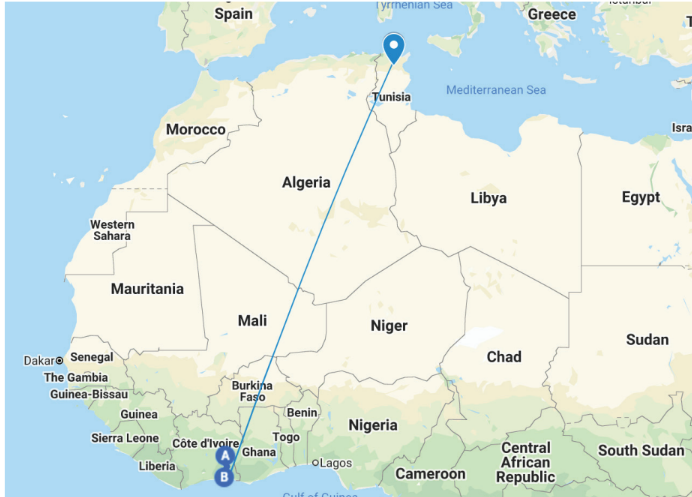
Her family paid 288,000 CFA ($494.00) for her flights, which they purchased through a travel agency recommended by the Ministry. Her father also gave her 250,000 CFA ($429.00) to pay for her initial expenses as soon as she arrived in Tunisia, but it wasn’t enough. “He had to send extra money a couple of times during my first months because the money was not enough,” she explains. Her father transferred an additional 150,000 CFA ($257.00) through Western Union to pay for furniture, food, and the deposit for her flat.
“In Tunis, the scholarship money only covers for tuition fees and that little allowance, but we have to figure out housing,” Clara says. She mentions that there are student halls which she can rent out for 30–40 TD ($10.40–$13.80) per term, but she didn’t feel comfortable when she visited. “There are too many people; you feel compressed,” she explains.
Under the advice of an older sister, she found her first apartment through Facebook. Two Congolese girls were looking to fill the third room in their apartment, where she stayed from October 2017 to June 2018. “Initially, the room was supposed to be 200 TD ($69.30). The first month I had to pay the rent plus a one-month rent deposit, so it came up to 400 TD ($138.60) per person. We also had to give an 80 TD ($27.80) commission to the Congolese who found the house. A month later, the landlord increased the rent to 220 TD ($76.20). In April, the landlord tried to force them out with a month’s notice, but they used their deposit as leverage for an extra month. They were also made to pay to paint the walls for 150 TD ($52.00) per person. “Maybe we could have spoken to the police, but I’m not sure if I would have. I don’t think there are any organizations we can contact for this,” she laments.
She currently lives in an apartment with four other girls where she pays 231 TD ($80.00) a month. In addition to the first month’s rent, she also had to pay an additional two-month deposit, totaling about 690 TD ($239.00). “Our landlord doesn’t live near us, or above us, so we don’t have any problems. We also have our own meter, but the bills really vary according to the season and the amount of people staying in there,” she explains. The bills can vary from 400 to 1,000 TD per month ($138.00–$346.00).
Aside from her apartment rent, Clara says that her biggest expense is transportation. “My school is a bit far from my house, and I rarely take the bus because it’s very irregular and slow because of traffic. It can make me come into classes 30 minutes or an hour late. I take it for my returns because then I can afford to be late,” she explains. She spends anywhere between 3.5–7 TD ($1.21–$2.40) per taxi ride, depending on the traffic.
The partial scholarship she receives amounts to about 1,250 TD ($433.00) per year, split over three or four transfers. “I think I got 300 TD ($104) in October, and then 200 TD ($69) in January. This year, there were a lot of delays,” she says. In addition to the scholarship, her parents transfer about 180,000 CFA ($309.00) to her through Western Union to pay for her living expenses. Her father wanted to open a Tunisian bank account and was told that money transfers were possible, but the services never actually worked. They also considered getting Clara a Visa card but found out about this option after it was too late. “It’s very hard to send money,” she says. “It’s impossible.”
Clara mentions that she would like to get a job in the summer for some pocket money but is worried about being exploited. “I find it hard since there are no good jobs for us,” she explains. “I think students work a lot and are paid less.” She says that she often borrows and lends small amounts of money to her friends for little treats, about 10–20 TD ($3.40–$2.90) or up to 100 TD ($34.00) at a time. “I don’t give a date for them to return the money. If they can’t give it by the time they say they will give it back, I understand. Some people have a lot of difficulties,” she explains.
She then goes on to describe some other difficulties she’s had with living in Tunisia. “I haven’t really made Tunisian friends. It’s true that I often face racism, but I don’t pay attention,” she says. But in 2017, she says that things got a bit tricky because one of her professors refused to speak French during his lectures, although it is the official language they are supposed to teach in. “He started speaking Arabic only, so we wouldn’t understand. When we asked him to speak French, he asked us to learn Arabic because other students couldn’t understand French. That really disgusted me.”
Despite these instances, Clara says that she feels integrated in Tunisia because she can spend time with other Sub-Saharan migrants in the area. “I haven’t really made Tunisian friends, but personally, I think I feel integrated because my brothers are here,” she says. “When we’re together with our brothers, we forget.” She also plans on leaving Tunisia to pursue a master’s degree in the future.